Multi-teacher distillation for edge audio
Confidence-weighted knowledge distillation for sound event detection on a Raspberry Pi
- Context: Master’s thesis, Polytechnique Montréal × Atelier7Hz
- Focus: Sound event detection on edge devices
- Status: First-author paper in preparation (The repository is currently under NDA, but will be released alonside the paper.)
- Stack: PyTorch, Hydra, Ray Tune/Optuna, ONNX
Sound event detection models are accurate but too large for low-power devices. This project compresses an ensemble of strong audio models into a small student that can run on a Raspberry Pi 4B.
Results so far
- Teacher ensemble: built an ensemble that surpasses the state of the art on FSD50K (+0.4 mAP) with 93.7% fewer parameters.
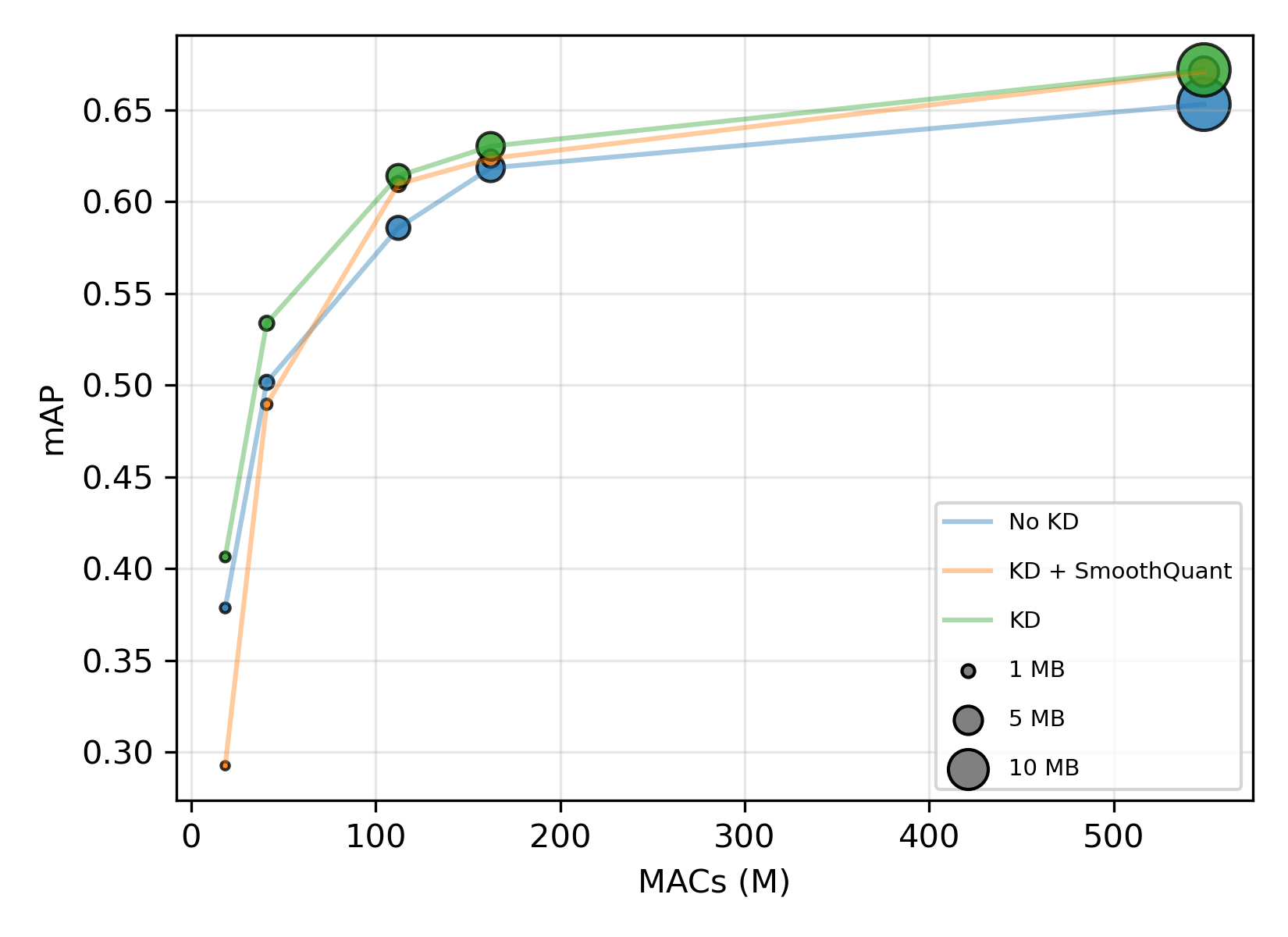
- Distillation method: designed a confidence-weighted multi-teacher method that distills BEATs, PaSST, AST and MobileNetV3 into an EfficientAT student. The student reaches 67.05 mAP, above every individual teacher (all below 65.3).
- Deployment: mapped the accuracy-compute Pareto front across pruning, INT8 quantization and combined schemes, to pick operating points for the Raspberry Pi 4B.
Engineering
- Wrote custom C++/CUDA kernels for mel-spectrogram computation (shared-memory 2D tiling), a 2x speedup over torchaudio on an RTX 5090 during training.
- Rewrote the inherited training pipeline (PyTorch, Hydra, Ray Tune/Optuna, ONNX) for scene classification and flyover detection. Removing unnecessary CPU-GPU synchronization calls made training 13% faster.
A first-author paper is in preparation.
Team: Mateo Mangialomini, Émilien René.